About Max Gimblett/Kongo Hitsu Kaku Shin
(Kongo Hitsu Kaku Shin, which means Diamond Brush, Awakened Heart)
ABOUT MAX GIMBLETT
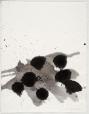
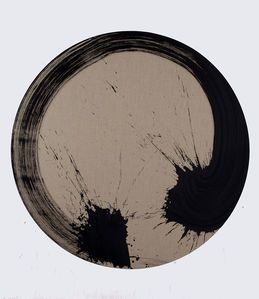
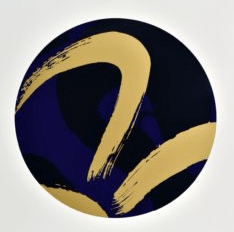
The following calligraphies below, were ‘brushed’ in response to a given ‘motiff’ -mass (physical), original mind (‘the face of the face of the mind before its own origination/birth’ was my take on it!), heart, staff, and bridge.
It was so refreshing and liberating to have my ‘inner well of knowing’ (‘original mind’?, ‘buddha nature’?) actually identified, talked to, encouraged and valued as a source for artistic inspiration and expression wherein the mind/brain (psyche; West/East psychology, philosophy, spirituality, divination )/body’ (senses and visceral feelings) come together for a single artistic expression in the form of a painting!
[It was like a dream come true -Max was reportedly scheduled to only visit New Zealand every second year now, with his next visit in November, but he arrived ahead of time!, and only by chance did I know that he was in town and that there was a public talk any day soon, and then, the first set of workshops were booked out!]

“Free-Falling Entity”


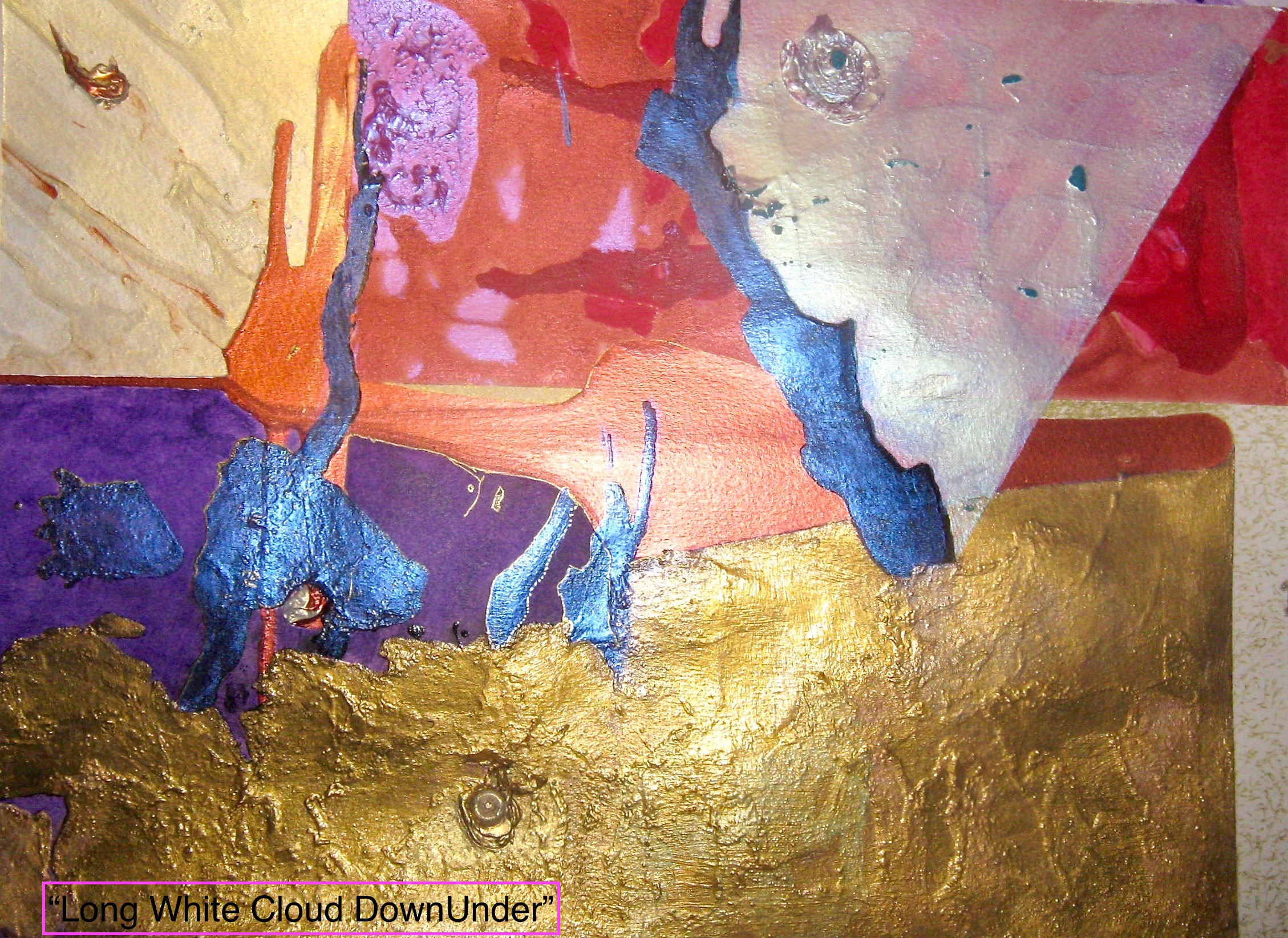
In March ’20 I have since revisited these brushings and transformed them into paintings as derived from how they ‘talked’ to me –
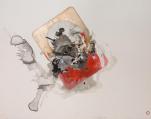
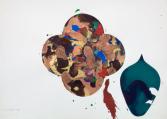
Tethering the Sovereignty of a Golden Goose: the Will, Determination and continual Transforming of LGBTQIA+ people in response to the perpetuation of hetero-normative male mindsets within almost all psychologies, philosophies, religions, spiritualities “, Oneroa, Waiheke Is., Auckland -re-created from a Sumi ink brushing motiif called “bridge” using photographic collage; interference and iridescent acrylics, metallic pens and pencils on watercolour paper
Postscript:
What an amazing opportunity to have been on a Max Gimblett, Sumi-ink calligraphy workshop for two hours yesterday.
Thank god/the goddess that AUT pursued, and he agreed to put on some public workshops.
Max made reference to his own ageing and the need for therapy as he was identifying as living as a forty-something, instead of as an eighty-three year old, together with how he was responding to the unfinishedness of the new studio back home, compared with his partner’s response as a different and somewhat younger person.
For the last week, I too have had to live around a daily life fear of ageing as a sixty-eight year old -feeling a fear of generalized fear from the past through to the present and on into the future that needs to be deconstructed and brought to a resolve in the here and now, yet to re-visit again uninvited, no doubt!
During a Quaker group meditation the next day, I recognized the cosmic joke of thinking that I was somehow resistant to the not okay feelings of a dualistic life but practising from within a tradition steeped in non-dualism! ie. the mud and the lotus flower are one! as per my Thich Nhat Hanh practice.
It was like a ‘heavenliness’ coming to town for a few hours, and I was one of ‘the chosen few’! Not only to have attended, but also in how Max spoke to us as an individual and as a group.
There was something heartening about Max in that he is Kiwi through and through, it just so happens that he lives in New York, and made good, there, in the art world.
Heartening, in that his social persona does not appear to have been Americanised, attracted ‘baggage’, and, his genderisation as a New Zealand male still allows him to be self-disclosing and interpersonally engaging while at the same time, a Kiwi bloke in appearances, anyway!
The ambience in the room was set by being informed of how to pick up the paper, by making reference to the life and “spirit” of the paper, and, for all “domestic energy” (bags, cellphones etc.) to be left at the back of the room.
Although Max comes from a particular Zen Buddhist tradition, there was an all-encompassing and non-dogmatic aspect to his presentation in terms of making mention of “there are no rules” and his making use of the resources of a particular tradition and/or practice irrespective of whether they have a ‘faithfulness’ of fact, logic and/or fiction, and, in whatever way we wish.
To be in a room with about thirty other people and artists -to do, hold up our work, and be critiqued in public, as well as a closing conversation for each person with Max in discussing those calligraphies to be taken home, and/or be further commented on!
It was inspirational in that I was affirmed as an artist in my own right and in a wholistic way -a totality of being in a moment of time, in terms of my predominant process come modality -ie. on the naming of a motif, directing my thoughts to a ‘within-ness’ (“original mind”?) come meditative place within my brain, and thereby towards a ’void’ of ‘inner knowing’ (that I have been familiar with from about seven years of age as an adult child), and then, without almost any reservedness in a group situation, being able to spontaneously move my body and/or make a sound as the inked brush in my hand ‘channeled’ an expression from my brain/mind, integrated within my sensory systems and along my arm, onto the paper.
Briefly Max also drew attention to the three parts of the brush, how much ink was used and the manipulation of the brush ie. staying in contact with the paper etc.
I am now left pondering the idea that Max’s down to earth commonsense and matter of factness allows us to invite in and participate in both the relative and ultimate realms of the human condition of daily life without the structuralism of institutional religion/psychology/philosophy/spirituality.
Te aroha (Love)
Te whakapono (Faith)
Me te rangimarie (And peace)
Tatou tatou e (Be amongst us all) https://www.youtube.com/watch?v=uefJdSCkzPo
Max Gimblett has been at the forefront of New Zealand painting for over two decades. With philosophies and practices that encompass influences as varied as Abstract Expressionism, Modernism, Eastern and Western spiritual beliefs, Jungian psychology, and ancient cultures – Gimblett’s work holds a special place in recent New Zealand art history.
Born in New Zealand, Gimblett has been primarily based in New York since 1972, and continues to exhibit regularly in both places. This ‘straddling’ of countries, and the travel that goes along with it, is of great significance to Gimblett’s ideology. “The influence of Zen seems natural to Gimblett, and carries with it an echo of Asia’s proximity to New Zealand, but also can be traced partly to American artists with West Coast connections such as Clyfford Still and Mark Tobey. Gimblett has made a harmonious post-war synthesis of America and Japan.” (Thomas McEvilley, ‘The Transition from Three to Four,’ Max Gimblett: The Brush of All Things, Auckland Art Gallery, 2004, p.9)
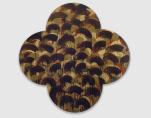
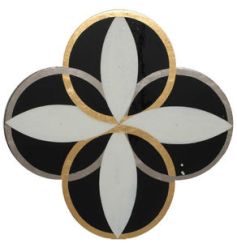
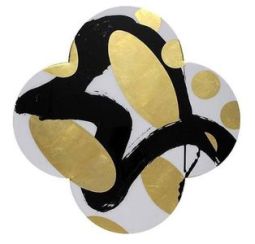
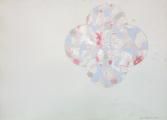
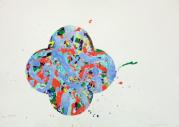
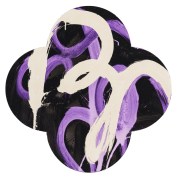
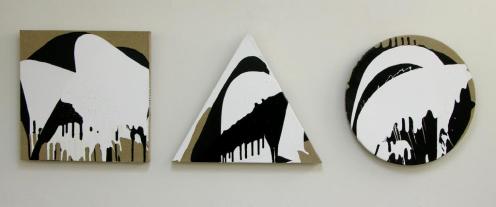
This mix of cultures and aesthetics is evident in Gimblett’s work, which consists largely of object based paintings. His range of shaped canvases convey various associations and meanings connected to the oval, rectangle, tondo, keystone, and quatrefoil (of which Gimblett is most recognised). It is Gimblett’s intention in these works to explore the multiplicity of meaning attached to such revered objects. The quatrefoil shape dates back to pre-Christian times and is found in both Western and Eastern religions symbolising such objects as a rose window, cross, and lotus. “By choosing to work on quatrefoils, Gimblett moves away from pure or non-referential geometry towards a geometry that is loaded with symbolic associations. At the same time, in the realm of physics, the quatrefoil can suggest the existence of a fourth or unattainable dimension. It also indicates a stable form undergoing transformation, both expansion and contraction, like a flower.” (John Yau, ‘Going Forth’, Max Gimblett, Craig Potton, 2002, p. 107)
Gimblett steps further into exploring spiritual beliefs through his use of precious metals. Materials such as gold and silver are religiously associated with honour, wisdom, enlightenment and spiritual energies. “Gimblett is not the first post-war artist to use gold or to be interested in shaped canvases, icons and iconicity. Within this context one must consider Frank Stella, Yves Klein, and Andy Warhol. Gimblett’s interest, however, is in the spiritual rather than the earthly. He rejects Stella’s coldly cerebral literalism, Klein’s arch ironies, and Warhol’s sly incorporation of Hollywood stars. In contrast to Klein, Gimblett uses gold in a way that is neither tawdry nor purely about visual pleasure. Rather, gold and silver are transmitters of light.” (John Yau, ibid, p. 107-108)
The use of such materials brings a seductive quality to these paintings. Surfaces combine gold, silver, copper, bronze, epoxy, resin, plaster, paint and pigments. “Through a complex process that involves diluting epoxy resin in the paint, the artist has achieved a quality of surface that may be unique in modern painting. It looks like porcelain, glowing from within while still shining on the surface. This technique seems somehow to emphasize both surface and depth; the drawn elements acquire a new sharpness and stand out more assertively against the ground.” (Thomas McEvilley, ‘The Shape of Energy,’ Art in America, October 2005, p. 167) These extremely delicate surfaces are carefully prepared and cured, but are only one part of Gimblett’s diverse practice. These serene surfaces are often disturbed by bold gestural brush marks in acrylic polymers and paints.
Gimblett has an extensive collection of brushes, mops, and rollers with which he makes his marks. “I work fast. De Kooning said he painted fast to get to the other side of the street. I work in bursts of one point, very sharp concentration and then rest and then have another burst or set of gestures.”(Max Gimblett, artist statement, 2002) These gestural paintings with their drips, splatters and swipes of paint strongly ground Gimblett in the tradition of American Abstract Expressionism; yet at the same time maintain a link to Eastern calligraphic practices. There is a performance aspect to the creation of work. “I am committed to the Buddhist idea of the ‘not self’ and in that sense, I try to suspend judgement, and ‘float’. As an intuitive thinker, my imagery comes to me as I command, as a whole unit – the mind is cleared, an image arrives and I execute this quickly.” (Max Gimblett, Eyeline, Summer 1997/98)
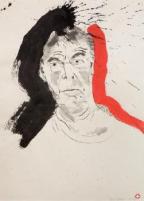
Alongside his paintings Gimblett produces an ongoing series of works on paper. In 2002 a survey of these works were exhibited at the Queensland Art Gallery in Australia. “Gimblett views his drawings as a major aspect of his oeuvre, and few artists of his generation have produced works on paper so regularly with so much commitment. They have spiritual and metaphysical connotations, combining both Eastern and Western impulses, and represent either a slow, layered approach to building up an image – which is often a geometric symbol – or they are what Gimblett terms ‘quick, with no mind’”(Anne Kirker, Max Gimblett: The Language of Drawing, Queensland Art Gallery, 2002)
Limited edition books, often produced in collaboration with writers, are also a passion for Gimblett. In 2006 he released Searchings (published by Holloway Press, The University of Auckland), highlighting drawings and writings from the archives of Gimblett’s journals, with each volume bound with two original ink drawings. Other publications include Mondrian’s Flowers (published by Granary Books, New York, 2002), and The Dogs of Auckland in 2000 (published by Holloway Press, Auckland University). These collaborations are important to Gimblett for both the new medium presented, as well as the ongoing cross discipline dialogue. Other artists’ books include projects with John Yau, Lewis Hyde, and Chris Martin.
New Zealand jeweller Warwick Freeman is also a long time collaborator, working with Gimblett on such significant pieces such as Spirit Box (1998). Gimblett worked with renowned furniture makers Jim Cooper and Humphrey Ikin to create this cabinet of drawers. Minimal and sculptural when closed, when opened they revealed a series of skulls in a range of materials – paua shell, felt, cow bone, glass, wood, shell, and mother of pearl. “This is an exhibition in a box, a show in the shape of a display case. Because the box itself is so unadorned – an embodiment you could say of self containment – the shock of entry, of pulling open the first drawer, is all the greater. There in the tray, staring you in the face, in silhouette, is a grinning death’s head, exquisitely finished in polished paua shell. Close it up and open the next drawer and there it is again – no getting away from it… it’s a treasure… its success arises from Gimblett’s continuing renegotiations of the margin between sculpture and painting. (Wystan Curnow, Art Asia Pacific, No. 23, 1999)
In 2002 a major monograph on Gimblett’s work was published providing insight into various aspects of Gimblett’s practice. With over 100 full colour reproductions this book maps the development of his exceptional career, from the rarely seen geometric paintings of the 1970s, through a myriad of shapes and techniques, to his current works that are just as stylistically diverse.
In 2004 Gimblett’s standing as a senior New Zealand artist was affirmed by the survey exhibition, The Brush of All Things, curated by Wystan Curnow. The exhibition toured two of the country’s major public galleries – the Auckland Art Gallery and the City Gallery Wellington, and included over forty major works from public and private collections. In 2005 Gimblett was appointed to the honorary position of Visiting Professor at the National Institute of Creative Arts and Industries, Auckland University.
Gimblett continues to exhibit widely in the United States, Europe, Asia, Australia, and New Zealand. His work is represented in major public and private collections around the world, including the Art Gallery of NSW, Queensland Art Gallery, Auckland Art Gallery, San Francisco Art Institute and the San Francisco Museum of Modern Art.
Text courtesy of Gow Langsford Gallery.


*See “An Original Mind” documentary (Vimeo) about Max Gimblett -with permission from Matt Jones, Studio Manager, matt@maxgimblett.com and producer Rhys Mitchell, mail@smallgreenhill.com https://nzentertainmentpodcast.com/max-gimblett-original-mind-50-min-director-rhys-mitchell-review-glenn-blomfield/
http://www.pageblackiegallery.co.nz/artists/max-gimblett/
http://www.nadenemilnegallery.com/artists/Max-Gimblett/Max-Gimblett-All-That-Is
https://www.invaluable.com/artist/gimblett-max-kmy74jbtst/sold-at-auction-prices/
https://christchurchartgallery.org.nz/mygallery/dflrm
http://reelgood.com.au/articles/10-questions-lewis-mitchell/
 *Art, Artistry from Within*, Waiheke Island, Auckland, New Zealand/Aotearoa, South Pacific Ocean. Michael Ocean